
Table of Content
How TWS helps businesses build better products faster, with less overhead
The global software development outsourcing market is to hit $940 billion by 2034, according to Market.us. Behind those numbers is a straightforward reality: companies that outsource software development gain faster delivery, lower costs, and access to engineers they simply cannot hire locally.
This guide covers everything you need to know from the business case and engagement models to vendor selection and day-to-day management, so you can decide whether outsourcing software development is right for your organization and, if so, how to do it well.
Why do companies outsource software development?
The decision to outsource software development rarely comes down to a single factor. Most companies are dealing with a combination of talent shortages, budget pressure, and timeline constraints that internal teams alone cannot solve.
According to a recent report from Grand View Research, the IT services outsourcing market hit $807.91 billion, with an expected 8.6% CAGR through 2030. Within that figure, software outsourcing stands out as one of the fastest-growing segments at 11.5% CAGR. That growth reflects practical business decisions across thousands of companies.
The most common reasons businesses pursue software development outsourcing include:
- Cost reduction: offshore and nearshore engineers typically cost 40–70% less than equivalent US or Western European hires, when accounting for salary, benefits, office space, and equipment. TWS customers report an average IT cost reduction of 40%, which tracks with the broader market data.
- Access to specialized skills: AI, blockchain, cybersecurity, and cloud-native development require expertise that most companies cannot build internally fast enough.
- Faster time to market: McKinsey found that outsourcing software development can cut time-to-market by up to 25%.
- Scalability: outsourced teams can be scaled up or down based on project demand, without the risk and cost of layoffs or long hiring cycles.
- Focus on core business: delegating software development to a specialist partner frees internal teams to concentrate on product strategy, sales, and customer success.
Outsourcing models: which one fits your project?
Not all software development outsourcing looks the same. Choosing the right engagement model is one of the most important early decisions, because it determines how much control you retain, how costs scale, and what type of talent you access.
Offshore outsourcing
Offshore outsourcing means working with a vendor in a distant region, typically Eastern Europe, South Asia, or Latin America. The cost savings are the highest here, but the time zone difference and cultural distance require more deliberate communication processes. India, with over 5.8 million IT professionals, and Ukraine, with a market valued at $3.7 billion, are two of the largest offshore software hubs.
Nearshore outsourcing
Nearshore vendors operate in countries close to your own, sharing similar time zones. For US companies, this often means Colombia, Mexico, or Argentina. For Western European buyers, it means Poland (market size $3 billion in 2024), Romania ($415 million), or Bulgaria. Nearshore outsourcing balances cost savings with easier collaboration. TWS is structured specifically around this balance, their availability hours overlap across numerous time zones, with little to no cultural distance, which keeps communication fast and straightforward.
Onshore outsourcing
Onshore outsourcing involves hiring a domestic vendor. Communication is simplest, legal compliance is straightforward, but the cost premium is significant. According to Grand View Research, the onshore segment held the largest market share in 2024, driven by companies that prioritize data security and operational control.
Dedicated team model
Rather than handing off a fixed project, you hire a team of engineers who work exclusively for you, but are employed and managed by the outsourcing partner. This model works well for long-running product development where you want tight integration with your internal team without the overhead of employment. TWS offers this as one of their four engagement models, positioning the dedicated team as an extension of your in-house IT department that follows your business standards, scheduling, and rules.
Project-based outsourcing
You define a scope, budget, and timeline, and the vendor delivers. This suits well-defined projects like building a specific feature, a mobile app, or a data migration. It requires strong upfront requirements and clear acceptance criteria to work well.
How to outsource software development: a step-by-step process
The companies that get the most from outsourcing invest time upfront in defining what they need, vetting partners carefully, and setting up the right processes for ongoing collaboration.
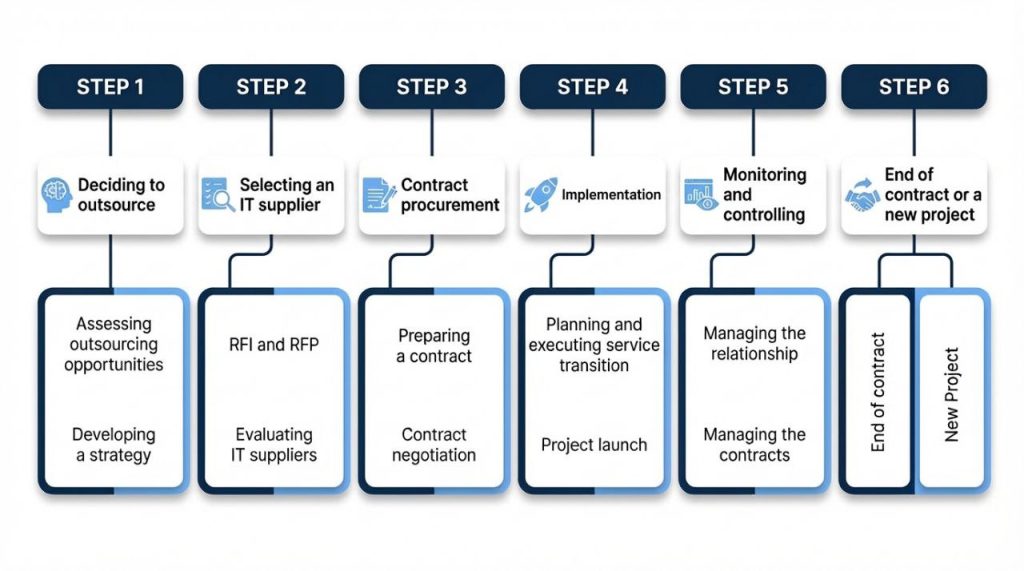
Step 1: Define what you are outsourcing and why
Before approaching vendors, write down the specific outcomes you need. Also clarify why you are outsourcing: cost, speed, skills, or all three. This shapes everything that follows.
Step 2: Decide on an engagement model
Use the model comparison above to determine whether a dedicated team, project-based contract, or hybrid approach fits your situation. Consider the duration of the work, how much the scope may change, and how closely you want the outsourced team to integrate with your internal staff.
TWS offers four clearly defined models, Fixed Price, Time & Material, Dedicated Team, and Managed Services, so you can match the engagement structure to your actual project needs rather than adapting your project to a vendor’s preferred billing method.
Step 3: Define your vendor criteria
Choosing software development outsourcing that fits your needs requires clear criteria before you start talking to vendors. The most important factors are:
- Technical stack match: the vendor must have proven experience in your specific technologies
- Industry experience: a vendor that has built healthcare software before understands HIPAA; one that has built fintech products understands compliance requirements
- Team size and scalability: can they staff up quickly if scope expands?
- Communication standards: what tools do they use, and what does their process for status updates and issue escalation look like?
- Security and IP protection: do they sign NDAs, and what does their data handling look like?
- References: can they provide clients you can speak to directly?
Step 4: Request proposals and evaluate
Send a detailed brief to three to five vendors. Evaluate their proposals not just on price but on how well they understood your requirements, the seniority of the engineers assigned to your project, and the specificity of their delivery plan. A vendor who asks clarifying questions before proposing is a better sign than one who quotes immediately.
Step 5: Run a paid discovery phase
Before committing to a full engagement, pay for a short discovery phase, typically two to four weeks. The vendor maps out architecture, identifies risks, and produces a more detailed plan. This also lets you evaluate how they communicate and whether they surface problems early. Skipping this step is one of the most common reasons outsourced projects run over budget.
TWS offers free IT consultations with no obligations before any engagement begins, which gives you a lower-stakes starting point to evaluate fit before committing to a paid discovery phase.
Step 6: Set up communication and delivery processes
Knowing how to successfully outsource software development means building communication structures that work at scale. Agree on a daily standup cadence (or async equivalent), a sprint review schedule, a shared project management tool, and an escalation path for blockers.
The goal is to make the outsourced team feel like an extension of your own. TWS operates on 100% Agile principles, Scrum, Kanban, and custom approaches, with CI/CD pipelines and fast delivery cycles built into their standard process, not bolted on as options.
Step 7: Measure outcomes
Track delivered features, bug rates, test coverage, and deployment frequency. Outcome-based measurement is standard in modern outsourcing contracts and aligns vendor incentives with your goals.
What to look for when choosing a software development outsourcing partner
The vendor selection process is where most outsourcing relationships are won or lost. A vendor who looks good on paper can still fail to deliver if there is a mismatch in culture, communication, or technical approach.
Beyond the criteria listed above, pay attention to these signals:
- Portfolio depth – do their case studies show projects of a similar size and complexity to yours, or do they consist mostly of simple MVPs?
- Engineering seniority – a team stacked with juniors and one senior lead is a risk for complex projects. Ask for CVs of the specific people who will work on your account.
- Process transparency – vendors who can describe their code review process, testing strategy, and deployment pipeline in detail are more mature than those who answer with vague assurances.
- Proactive communication – in initial calls, does the vendor ask about your business goals, or do they jump straight to technical questions? The best partners understand that software is a business tool.
- Retention rate – high developer turnover at a vendor means institutional knowledge walks out the door mid-project.
TWS addresses the seniority and retention points directly. Their in-house engineers have 5 to 15+ years of experience, with B2+ English skills and cross-industry knowledge across global enterprises and startups. They run internal mentorship programs, regular upskilling, and tech competitions to maintain team quality, which contributes to their average customer tenure of approximately three years. That tenure figure matters: it means clients stay, which is a reliable proxy for consistent delivery quality.
Common risks in software development outsourcing and how to avoid them
Software development outsourcing carries real risks. Understanding them upfront is part of how to outsource software development effectively.
| Risk | Root cause | Mitigation |
| Scope creep | Poorly defined requirements | Run a discovery phase; document all requirements in writing before coding starts |
| Communication gaps | Time zones, language, unclear process | Establish async communication standards; use shared tools; schedule overlap hours |
| Quality issues | Insufficient testing; no code review standards | Require unit tests, integration tests, and code review as part of the definition of done |
| IP exposure | No legal protection | Sign NDAs and IP assignment agreements before work begins |
| Vendor lock-in | Proprietary tools or formats | Require all code to be stored in your repositories; avoid proprietary build tools |
| Key person risk | One engineer holds all knowledge | Require documentation; ensure at least two engineers understand each system component |
TWS addresses several of these risks through their stated practices: IPR protection and knowledge transfer are explicit parts of their standard engagement, and their zero-bureaucracy approach with honest, timely communication reduces the likelihood of gaps widening before they surface.
Outsourced software development: how to manage an ongoing engagement?
Once a project is running, outsourced software development requires active management to stay on track. The biggest mistake is treating the vendor as a black box, handing over requirements and waiting for a deliverable. That approach works for simple, fixed-scope tasks; it fails for anything complex or iterative. Effective ongoing management includes:
- Weekly or bi-weekly sprint reviews with the vendor’s team lead and your product owner
- A shared backlog in a tool both teams use: Jira, Linear, or equivalent
- A defined process for requirement changes, including how they are scoped, prioritized, and added to the backlog
- Regular security reviews, especially for projects handling customer data
- Quarterly business reviews to assess the relationship and recalibrate goals
Quality assurance deserves specific attention. TWS employs dedicated manual and automation QA engineers who detect, analyze, and fix bugs in real time and are also responsible for preventing issues before they occur. Their QA team provides round-the-clock testing and monitoring, documents every identified issue, and conducts quality and security audits.
Industries that use software development outsourcing most
Software development outsourcing is not limited to startups or small companies. According to Market.us, large enterprises held a 68.3% share of the global software development outsourcing market in 2024, driven by demand for complex systems in AI, cloud integration, and data analytics. The most active industries include:
| Industry | Primary outsourcing use cases | Key driver |
| Financial services (BFSI) | Core banking modernization, compliance automation, fraud detection | Regulatory complexity; need for 24/7 uptime |
| Healthcare | EHR integration, patient portals, telehealth platforms | HIPAA compliance; rapid digital transformation |
| Retail and e-commerce | Checkout optimization, inventory systems, personalization | Fastest growing segment (Grand View Research) |
| SaaS and tech | QA, DevOps, frontend/backend scaling | Speed to market; cost flexibility |
| Manufacturing | IoT integration, supply chain software, predictive maintenance | Industry 4.0 adoption |
| Logistics | Route optimization, tracking systems, warehouse management | Operational efficiency at scale |
TWS has delivered projects across more than 30 engagements for global enterprises and startups, with particular depth in JavaScript full-stack development (React, Redux-Saga, Vue.js, React Native, Flutter, Node.js) and DevOps. Their DevOps practice covers CI/CD pipeline setup, Infrastructure as Code, DevSecOps, cost-efficient autoscaling, and zero-downtime deployment, capabilities that are directly relevant to SaaS, fintech, and logistics use cases.
How to outsource software development: evaluating cost
Cost is never the only factor, but it is always a significant one. Rates for outsourced software development vary widely by region, seniority, and engagement type. The following figures reflect current market rates:
| Region | Junior developer ($/hr) | Mid-level developer ($/hr) | Senior developer ($/hr) |
| United States (onshore) | $80–$120 | $120–$180 | $160–$250+ |
| Western Europe | $65–$100 | $90–$140 | $130–$200 |
| Eastern Europe (Poland, Romania) | $35–$55 | $50–$80 | $70–$110 |
| Latin America | $30–$50 | $45–$75 | $65–$100 |
| South/Southeast Asia | $20–$40 | $35–$60 | $50–$80 |
These are broad ranges. The actual cost depends on the specific technologies required, the seniority mix of the team, the engagement model, and the vendor’s service tier.
When evaluating total cost, factor in: vendor management overhead (typically 5–15% of project cost), the cost of a discovery phase, tooling, and time spent on code reviews and integration work by your internal team.
Delegating software development: when it works and when it doesn’t
Delegating software development is most effective when the work is well-defined, the vendor has direct experience with your technology stack, and you have an internal person, a product manager, technical lead, or CTO, who can act as the primary contact. It is least effective when requirements are still evolving rapidly, when your internal team has no capacity to review work, or when the project involves highly sensitive systems with no documentation.
The companies that consistently get good results from outsourcing share a few traits: they treat the vendor as a partner, not a contractor; they invest in onboarding the outsourced team to their codebase and business context; and they measure outcomes rather than hours. The fact that TWS maintains an average customer tenure of ~3 years suggests their clients are doing this right and that TWS’s team structure makes it easier to sustain.
Why choose TWS for software development outsourcing
TWS is a software development outsourcing partner built for technology companies and enterprises that need reliable, senior-level engineering teams for complex, long-running product development.
Here is what sets them apart from a typical outsourcing software development provider:
- 50+ in-house specialists with 5 to 15+ years of experience
- 5+ years of expertise and 30+ delivered projects across global enterprises and startups
- Four engagement models – Fixed Price, Time & Material, Dedicated Team, and Managed Services – so the contract structure matches your project type
- Full-stack JavaScript and DevOps depth – React, Vue.js, React Native, Flutter, Node.js, REST API, CI/CD, DevSecOps, Infrastructure as Code
- Dedicated QA team with manual and automation engineers providing round-the-clock testing and security audits
- In-house UI/UX department for product design, prototyping, and full-scale mockups
- Zero bureaucracy with fast turnaround, IPR protection, and knowledge transfer built into every engagement
- Average 40% IT cost reduction per customer, with ~3-year average customer tenure
If you are ready to outsource software development or want to assess whether it is right for your situation, call us!
You May Also Like


Building Digital Solutions That Drive Results
We design and build scalable digital products tailored to your business goals — from web and mobile apps to complex systems.